Part 2 of 2. Part 1 was about the shows. This one is about the songs.
Quick test. Hum the Cheers theme. Now hum Seinfeld. You just did the bass with your mouth, didn’t you? Now hum the theme from Caroline in the City.
Exactly.
Caroline in the City finished #4 in 1995–96. Its theme was written by Jonathan Wolff, the same guy behind the Seinfeld bass, and almost nobody can hum it. That’s the whole question in one show. Did a great theme song make a great show, or did a great show make us remember the song?
How I scored “catchy”
I can’t measure catchy directly, so I built a score anyone can check. Five parts, ten points max:
- A. Billboard Hot 100 for the theme recording: 3 points for the top 40, 2 for #41–100.
- B. Other Billboard charts, like Adult Contemporary and Hot 100 Airplay: 1 point each, plus 1 for a #1, capped at 2.
- C. Released as a commercial single: 1 point.
- D. TV Guide’s list of the 60 greatest TV theme songs: 2 points for its ranked top 10, 1 for the unranked rest.
- E. Rolling Stone’s 100 Greatest TV Theme Songs (2022): 2 points for the top 20, 1 for the rest.
How the catchiness score adds up
Two shows did nearly all the scoring.
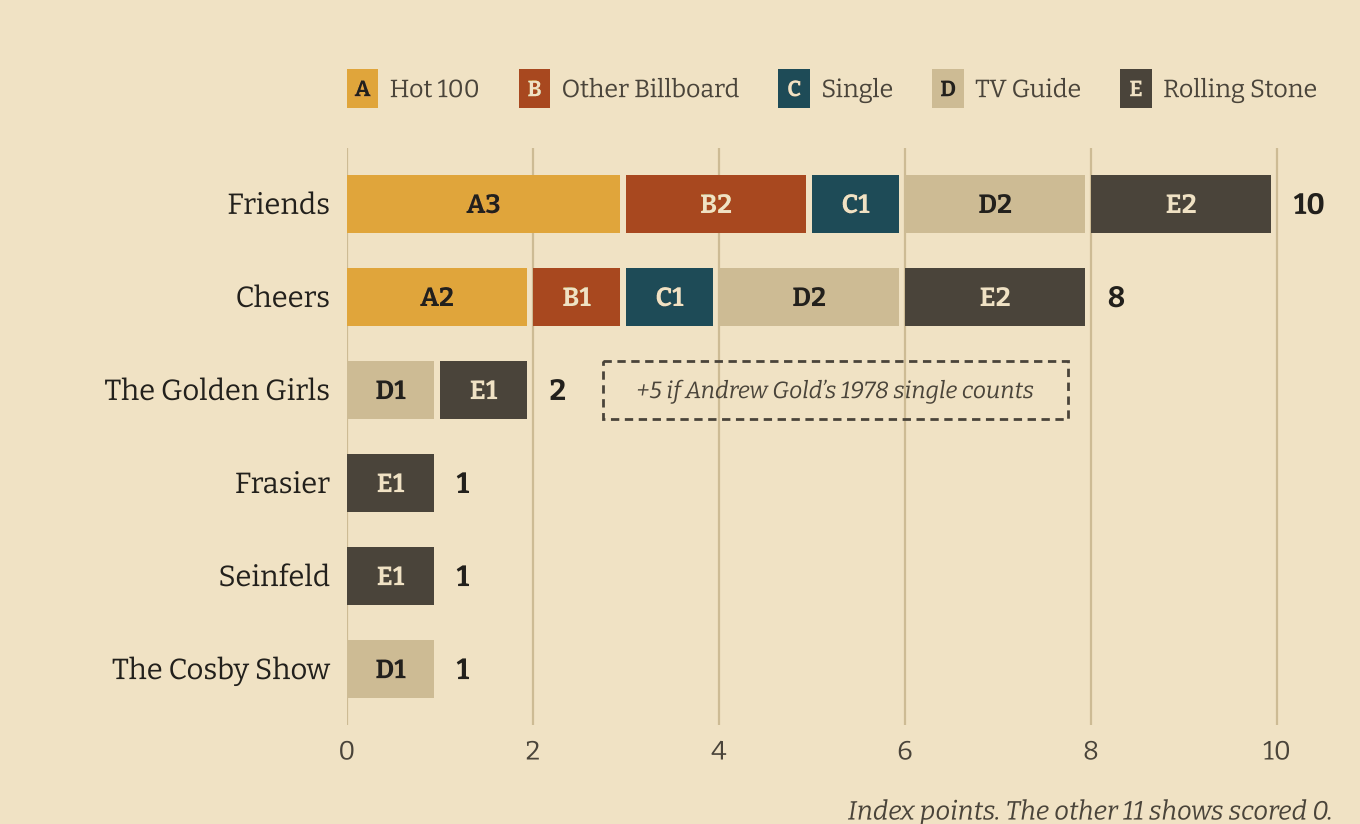
Friends scored a perfect 10 and Cheers got 8. Then it falls off a cliff. The Golden Girls got 2, three shows got 1, and the other 11 got nothing. A real hit theme is rare.
The Golden Girls comes with an asterisk. Its theme was Andrew Gold’s “Thank You for Being a Friend,” which hit #25 on the Hot 100 in 1978, seven years before the show premiered. Gold later called it “just this little throwaway thing” that took about an hour to write. Count that record and the score jumps to 7. I didn’t count it, because the show didn’t make that song a hit. Cindy Fee sang the TV version.
Andrew Gold’s 1978 recording.
Sung vs. instrumental
My gut said sung themes would win. Actually, my gut said they’d win easily. The 80s list has four sung themes and three instrumentals, so I lined them up. The sung shows averaged a 27.35 peak rating and the instrumentals averaged 27.3. That’s a twentieth of a rating point. Over their whole top-30 runs it flips, 23.4 for sung and 23.6 for instrumental. Dead heat.
Sung or instrumental
Four of the 80s top seven sang. Half the 90s list is still a question mark.

The 90s took more digging, because the research I started from had six of the ten themes marked unknown. One was a surprise: Grace Under Fire opened with Aretha Franklin singing “Lady Madonna.” A licensed Beatles song, the same move The Golden Girls made. Suddenly Susan started with a cover of “Ode to Joy” and later switched to a Shawn Colvin song. The rest I still can’t pin down, and I’m not going to guess.
With what’s confirmed, the 90s instrumentals actually come out ahead, 19.6 to 18.7, and most of that is Seinfeld. Rank tells the same story across both decades: the sung shows’ best seasons averaged #2.8, the instrumentals #2.5. Nobody wins.
Family Ties went with an original duet, “Without Us,” sung by Johnny Mathis and Deniece Williams from the 11th episode on. It scores a zero on my index, which tells you the index measures fame, not quality.
Johnny Mathis and Deniece Williams, the Family Ties theme.
The incredible shrinking opening
In Part 1, I mentioned ABC’s entertainment president calling title songs “an antiquated practice” in 1994. He also said the quiet part out loud: “I need to stop people from zapping.” NBC president Warren Littlefield called long title sequences clutter. CBS research chief David Poltrack pushed back, arguing titles matter early in a series, when they work as a prologue for first-time viewers.
Everyone’s model was Seinfeld. No title sequence at all, just Jerry’s stand-up with Jonathan Wolff’s bass underneath. Littlefield didn’t even like the bass. According to Wolff, he called it distracting, weird and annoying. Larry David’s answer: “Really? Annoying? Cool!”
The bass NBC wanted gone.
Frasier pushed it further: a brief title card, set to one of about 25 short musical cues, in a new color every season. The real song, “Tossed Salads and Scrambled Eggs,” played over the closing credits, sung by Kelsey Grammer.
Then Friends showed up with a full sung opening and a radio hit, and according to Variety, network executives rethought cutting themes, at least for a while. The 90s didn’t kill the theme song. They made it optional.
I wanted to chart opening lengths too, and I couldn’t. Almost nobody has published stopwatch times for these openings, and I’m not going to chart guesses.
The scatterplots that refuse to slope
Here’s the real test. If a catchy theme pulled in viewers, the high scorers should sit near the top.
Catchiness vs. best rank
Plenty of zero-point themes finished near the top anyway.

They don’t. The correlation between my catchiness score and a show’s best season rank is −0.20. That leans the right way, barely. With 17 shows, it would need to reach about 0.48 to count as more than noise. Against peak rating it’s 0.09, which is basically zero.
Catchiness vs. seasons on the air
Here’s the one that moves.
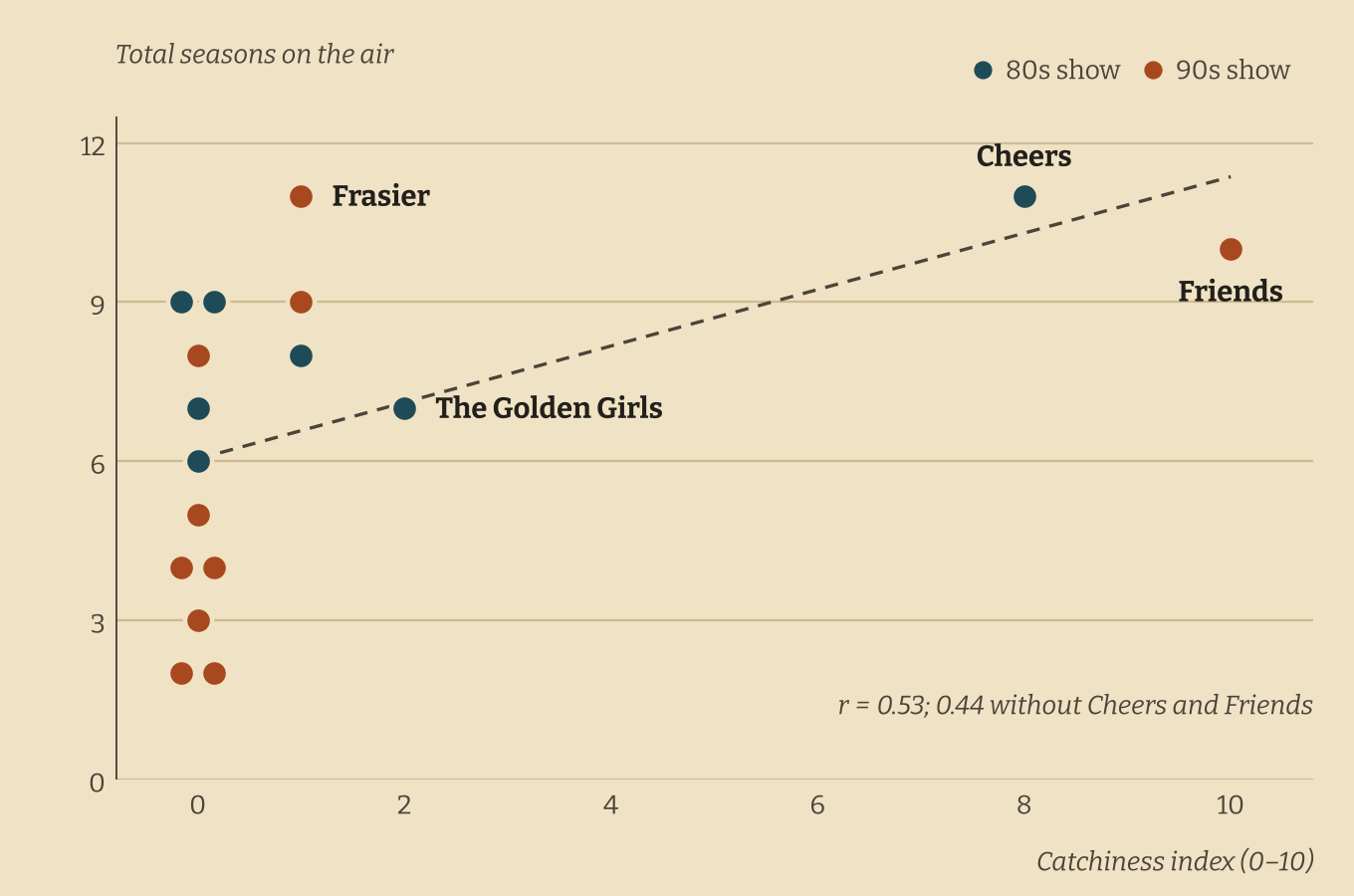
Seasons on the air is a different story. Catchiness against total seasons comes out at 0.53, which clears the bar. Take out Cheers and Friends and it’s still 0.44, so it isn’t just two shows. Shows with famous themes ran longer.
I think it runs the other way, though. Both lists in my score were put together decades later, and a show that ran 10 or 11 seasons had that much more time to burn its theme into your head. The timing backs that up. The Cheers single charted in 1983, while the show was still outside the top 30. Cheers didn’t get there until 1984–85. Friends was already a top-30 show by the time its theme took over the radio in 1995. Neither song led the ratings. The show made the song famous.
The two hits
The chart hits
One original hit per decade, twelve years apart.

Each decade’s top tier produced exactly one original theme that cracked the Hot 100.
Gary Portnoy and Judy Hart Angelo went through several rejected tries before Cheers said yes. An early draft opened with a list of everyday troubles, the Red Sox losing among them. Director James Burrows explained the rewrite years later: “You can’t do funny lyrics every week.” That group singing the chorus is Portnoy alone, overdubbed six times. The single peaked at #83. TV Guide later named it the greatest TV theme song of all time, which makes it the greatest theme song ever to stall at #83.

Gary Portnoy’s single version.
Friends went the other way. According to Michael Stipe, the show went to R.E.M. first, and R.E.M. said no. The Rembrandts’ “I’ll Be There for You” spent eight weeks at #1 on Billboard’s Hot 100 Airplay chart, hit #1 on Adult Contemporary, peaked at #17 on the Hot 100 and was Canada’s top single of 1995.
The four claps have two origin stories. Composer Michael Skloff says a drum fill went missing from the band’s final version, so he and three studio colleagues clapped. The Rembrandts remember the producers just wanting to try a clapping part. Either way, four claps.
The Rembrandts’ full-length version.
One more for the pile. The 90s theme that beat Friends on Rolling Stone’s list, #7 to #8, was The Fresh Prince of Bel-Air. That show was in my 90s pool of 47 and never cracked the top 10.
The verdict
So did the theme songs matter? Not to the ratings. I can’t find a link between a catchy theme and a big audience in either decade.
Two things are true at once, though. The 80s gave us more themes worth singing along to, and the one that charted is the one TV Guide put at #1. The 90s gave us the biggest hit of the bunch and proved a show didn’t need a theme at all. Seinfeld, the decade’s #1 show, didn’t even have a title sequence.
Go ahead and hum the Seinfeld bass on your way out. You already are.
Notes and sources. Small samples: 7 shows and 10 shows, so nothing here is proof. Vocal status is the opening theme in each show’s best season. The catchiness lists were put together decades after these shows aired, so the index leans toward long-running shows.
- Ratings: Nielsen season rankings via Wikipedia (Brooks & Marsh), the same data as Part 1.
- Chart peaks: Wikipedia’s pages for Where Everybody Knows Your Name, I’ll Be There for You and Thank You for Being a Friend, citing Billboard.
- Lists: TV Guide’s 60 greatest TV theme songs and Rolling Stone’s 100 Greatest TV Theme Songs (2022).
- The 1994 title-sequence fight and the Friends claps: Jon Burlingame in Variety (2023).
- Seinfeld’s bass: Jonathan Wolff to American Songwriter (2021). Andrew Gold’s quote: The Atlantic (2015).
- Cheers lyrics: Showbiz Cheat Sheet. R.E.M.: Looper, citing NME.
- Grace Under Fire and Suddenly Susan themes: Wikipedia’s Grace Under Fire and Suddenly Susan pages.
- Songs play through Spotify’s own player.
Leave a Reply